The short answer
Every pool runs on the same core chain of equipment: a pump to move the water, a filter to clean it, optional heating to make it swimmable year-round, and a sanitiser (chlorinator) to keep it safe - usually with automated dosing and app control layered on top, supported by carefully chosen pool water systems tailored to your lifestyle. The choices that matter most to a buyer are the pump (it drives your running costs), the filter (it drives your maintenance), and the sanitisation and dosing system (it drives how much time and money you spend keeping the water right). Get those three right, and the rest follows.
Pool equipment includes pumps, filters, and sanitisers to maintain water quality.
Why this guide exists
When you buy a pool, you are handed a spec sheet full of terms nobody explains: salt versus mineral versus magnesium chlorinators, pH and ORP sensors, “smart” dosing, variable-speed pumps, cartridge versus glass-media filters. Most buyers nod along, pick from a menu they don’t fully understand, and only discover what they should have asked once the pool is in the ground, and it’s too late to change.
This guide fixes that. It walks you through every piece of equipment that runs a pool - what it does, what’s worth paying for, where the marketing ends and the engineering begins - so you can make a confident, educated decision before you sign. It’s written for the buyer, not the existing owner, and it draws on nearly four decades of hands-on experience from our equipment specialist, Barry Mackay, who has worked with pool equipment since 1988.
A quick note on how to read it: we tell you the truth, including where cheaper options are genuinely fine. The goal isn’t to upsell you - it’s to make sure you never look back and say “I wish I’d known.”
What pool equipment actually runs a pool
The simplest way to understand how a pool system works is to follow the water. A pool is just a vessel that holds water; the equipment is what keeps that water clean, clear, safe and comfortable. As Barry puts it, the pool pump is the heart - everything else is an organ the water passes through on a loop.
A pool pump circulates water through the filtration system.
Pool equipment includes pumps, filters, and sanitisers to maintain water quality.
Here’s the circuit, in order:
- Pump - draws water from the pool through the skimmer box as part of the circulation system; skimmers collect surface water and pass it through the strainer pot before the pump works, with the electric motor then pushing it into the filtration system. Nothing happens without flow.
- Filter - strips out the fine particles, down to a microscopic level, so the water runs crystal clear.
- Heater (optional) - sits after the filter, so only clean water passes through the heat exchangers.
- Sanitiser / chlorinator - treats the water so it’s safe to swim in, usually followed by automatic pH correction.
- Back to the pool - filtered water returns through the return jets or outlet pipe into the pool, and the loop starts again.
Regular filtering and sanitation are essential for safe swimming conditions.
The order matters more than most people realise. Heating always goes after filtration (you never want dirty water in a heat exchanger) and before chemical dosing (high chlorine and acid will destroy a heater’s internals). The very last thing in the line is always the acid dosing. Get this sequence wrong - put a heater after the chlorine and acid, for example - and you can cook a five-to-ten-thousand-dollar heater in six months and void its warranty. It’s one of the clearest signs of whether a pool has been plumbed by someone who knows what they’re doing.
To keep water safe and legal, that circuit has to do three things: treat the water to a safe sanitiser level, filter it down to a fine micron level, and turn the whole pool over at least one and a half times a day - exactly what a complete, engineered pool system is designed to manage reliably in the background. In practice, how a pool works day-to-day depends on pool size, season, and equipment setup, so proper pool maintenance often means running the pump and filter anywhere from 2 to 8 hours a day to keep the system reliable across the entire pool. Each piece of equipment below is designed to hit those three targets reliably and affordably.
What you genuinely need versus nice-to-have: the pump, filter and sanitiser are non-negotiable - they’re what make the water safe. Heating, automated dosing, app control, and premium cleaning are where personal preference and budget come into play. None of them is essential, but as you’ll see, a couple of them are the upgrades buyers most often wish they’d taken.
Chlorination and sanitisation: salt vs mineral vs magnesium
This is the single most confusing part of buying a pool, so let’s clear it up first: a salt chlorinator, a mineral chlorinator and a magnesium chlorinator are, mechanically, the same device. As Barry says bluntly, “it’s all marketing.”
How Salt Chlorinators Work
Salt chlorine generators convert salt into chlorine using electrolysis.
Here’s what’s actually happening. A salt chlorinator is really an automatic chlorinator with a cell containing titanium-coated plates (an anode and a cathode). You dissolve sodium chloride in water; as that salty water passes across the plates, electrolysis generates its own chlorine, which then becomes hypochlorous acid in the water and destroys organic matter. That’s the whole job. The salt is simply the conductor that makes the chlorine.
Sanitisers eliminate bacteria and algae in pool water.
Mineral and Magnesium Additives
So where do “mineral” and “magnesium” come in? They’re not a different machine - they’re a different bag of salt you tip in. A “mineral” or “magnesium” pool runs a blend (in our case, roughly 70% salt and 30% magnesium). The salt still does the conducting and chlorine-making exactly as before; the magnesium just sits in the water and changes how it feels. That’s the key fact no brochure spells out: any salt chlorinator can run a magnesium blend - the magnesium isn’t a hardware feature, it’s an additive.
So what’s the actual difference to you, the swimmer? A magnesium-blend pool feels noticeably softer and silkier than a straight salt pool, which can make swimming feel more comfortable. It also tends to look more vibrant and clearer, because magnesium acts as a mild natural flocculant - it gathers fine suspended particles together so they settle or get filtered out, which slightly supports your filtration. That’s a genuine, noticeable difference in water quality.
The honest downside of magnesium: because it’s continually gathering particles, it loads up your filters faster - so you’ll be cleaning your filters more often. Beautiful water, a bit more filter maintenance. That’s the real trade-off, and most people happily take it.
Straight salt has essentially no downside as long as you don’t let salt levels climb too high. It’s a perfectly good choice. Most buyers simply prefer the feel of a magnesium pool once they’ve experienced it, and this sanitising approach helps keep the pool safe by controlling bacteria and algae.
Salt Levels and System Differences
Here’s where a real hardware difference does exist - and it’s about salt levels, not minerals. A conventional chlorinator needs a fairly high salt concentration to work - typically 3,000 to 4,000 parts per million (ppm). At that level you can’t really taste it, but you can feel it. Our low-salt system (the Chilli Fresh 280) is engineered to run at a much lower 900-1,500 ppm. For context, the ocean sits around 35,000 ppm, and a well-run domestic pool should be clean enough that you could, in principle, drink it - it’s a water-treatment plant.
The only reason to upgrade to the low-salt system is if you want that lower salinity. It’s made possible by adding a UV element (Chilli Pure) to share the sanitising load, which lets the chlorinator run at lower salt without being overworked.
One thing worth understanding about salt levels: running a chlorinator with too little salt actively shortens its life. When conductivity drops too low, the cell draws more current, overheats the terminals, and starts breaking down the titanium plates instead of the salt - and that can cut the life of an expensive salt cell by more than half. So if your chlorinator’s “add salt” light comes on, it’s not a suggestion. Keeping salt levels right is one of the cheapest ways to protect the most expensive part of your sanitiser.
Dosing and water management: “smart” vs “dumb” dosing
Part of keeping water sanitised is maintaining chemical balance, which is crucial for both water quality and equipment longevity. Part of that balance is keeping your filtration performing properly, which means cleaning your pool’s cartridge filter correctly at regular intervals.
ORP and pH Sensors
The two sensors you’ll see on a spec sheet:
- ORP sensor: Measures the available chlorine in the water, in millivolts. Run a pool at around 700 mV and you’ll sit at roughly 1-2 ppm of chlorine - exactly where you want it.
- pH sensor: Measures how acidic or alkaline the water is, on a scale of 0-14. Humans (and most pool surfaces and equipment) are happiest around neutral. Every time a salt chlorinator produces chlorine, it triggers a strong alkaline reaction, so the pH tends to rise. Let it drift up to around 7.8 and held there, and you start etching pool surfaces, fittings and equipment.
Standard vs Automatic Dosing
There are two ways to correct pH:
- Standard (“dumb”) doser: Adds a fixed amount of acid every day on a timer, based on a rough algorithm, regardless of what the water actually needs. There’s no feedback loop - it just keeps dosing until you manually change the setting. If conditions shift (heavy rain, a big pool party, a hot week), it’s wrong, and you don’t find out until you get the water tested and it’s way off.
- Automatic doser (our Chilli Balance): Has two probes constantly measuring the water and dosing only what’s actually required, in real time. It never stops monitoring.
Barry’s own framing is the cleanest: the standard system is a timer; the Chilli Balance is an automatic monitor-and-doser. The difference isn’t subtle.
Maintaining Water Balance
Why automatic dosing saves you money. Think of pool chemistry as a range. While your chemicals stay inside the acceptable range, the pool is happy and you spend almost nothing. The moment they drift out of range - too high or too low - you’re at the pool shop spending money to drag them back. An automatic system keeps you inside the range far more of the time, so you spend far less chasing problems. You can go away on holiday and the pool simply maintains itself at around 1 ppm with the pH held steady - no coming home to a green pool or a chlorine-bleached mess.
There’s a neat efficiency bonus, too. Because an automatic system only makes chlorine when there’s genuine chlorine demand, in a cooler climate like Melbourne the chlorinator might barely switch on for weeks at a time - it’s simply not needed - while the pump keeps the water moving. That changes how you should think about running costs (more on that under pumps).
A balance point worth knowing: every time the chlorinator pushes pH up and the acid doser pulls it back down, you get a swing. You stabilise that swing with sodium bicarbonate (pool buffer), keeping total alkalinity between about 80 and 120. A “dumb” doser tends to chew through more buffer because it’s constantly over-correcting; a measuring system is gentler. When you do add bicarb, add it gradually over two or three doses rather than all at once, with the pump running - dumping it in spikes the pH and the doser will just attack it with acid.
One myth to bust: automated dosing is not a cure-all. If you get algae forming in shady corners, that’s usually a flowproblem, not a chemistry problem - water sitting stagnant where the returns don’t reach it. The fix is circulation and return-jet aiming, not more chlorine. Good equipment helps, but don’t confuse filtration and flow with chemistry.
Three options. No complexity. Everyone works with HushHub Control from day one.
Learn More
Pool pump: the choice that drives your running costs
If you only get one equipment decision right, make it the pump - it’s the heart of the system and the single biggest driver of your ongoing electricity bill.
Single-Speed vs Variable-Speed Pumps
Single-speed vs variable-speed. An old-style single-speed pump runs flat out whenever it’s on, drawing around 53-54 cents an hour at today’s electricity rates. The pool pump is the main pump in the circulation system, driven by an electric motor that spins the impeller to pull water in and push it through the filter and back to the pool; that’s how a pool pump works. A modern variable-speed pump (direct current) can be programmed to move the same water far more efficiently, down around 12-15 cents an hour. Over the life of a pool, that gap is enormous. It’s why variable-speed pumps are now standard on quality pools, and why Barry expects them to become mandatory for domestic pools within a few years.
Sizing Your Pump
How we size it. The job is to turn the whole pool over 1.5 to 2 times a day. We program our variable-speed pumps to move roughly 200 litres a minute, which achieves that turnover in about six hours, even on larger pools - quietly and cheaply - rather than running a noisy single-speed pump hard all day to do the same work. Many pool ownersunderestimate how much run time is needed to keep their pool circulating properly.
Energy Efficiency Considerations
The mindset shift on running your pump. Because variable-speed running costs are so low, the old instinct to “turn the pool down in winter to save money” is outdated. More flow is better for the pool’s long-term health all year round, and with automatic dosing, there’s no risk of over-chlorinating, because the chlorinator only fires on demand. Choosing an energy-efficient variable-speed pump can significantly reduce energy costs for pool owners. As Barry puts it, you don’t stop driving a $120,000 car to save fuel - so why choke a six-figure pool? Run the water.
Over- or undersizing. An undersized pump won’t provide enough flow, and many pools have heat pumps and gas heaters that require a minimum flow rate to work at all. An oversized pump mostly just wastes energy and pushes water back into the pool too aggressively. The right pump is matched to the pool and everything attached to it.
What to look for as a buyer: Energy Star ratings if savings matter to you, and quality, proven Australian-market brands - think Hayward, AstralPool, or our own Chilli range - over the cheap units you’ll find on a hardware-store shelf. A pump is not the place to save a few dollars.
Pool filter: cartridge vs sand vs glass media
Pool filters remove dirt and debris from the water.
Filtration is measured in microns - the size of particle the filter can remove. For perspective, a single human hair is about 75 microns across. There are two main types of pool filter: sand or glass media filters and cartridge filters.
Cartridge Filters
Cartridge filters are the finest option on the market today. In overall pool filtration, their core function is to remove dirtand finer contaminants, and a good cartridge (like our Chilli Micro Cartridge) traps the small particles that affect water clarity, filtering down to around 10-12 microns when clean. Interestingly, they get more effective as they get slightly dirty, because trapped debris tightens the filtering - but past a point that also chokes flow, so they need regular cleaning.
How to clean a cartridge filter:
- Switch off the pump.
- Remove the cartridge from the filter housing.
- Hose it down with a garden nozzle (never a pressure cleaner - it shreds the pleats).
- Reinstall the cartridge and restart the system.
No special tools, no water waste.
A feature worth knowing about ours: the Chilli cartridge pleats are coated in an antimicrobial film (they’re blue, not the usual white), so the filter also acts as a built-in algaecide as water passes through - something very few cartridge filters do.
Sand and Glass Media Filters
Sand and glass-media filters use a filter tank that holds the filter media or filter bed. These filters use a bed of media - either sand or glass. Water passes through the media bed while dirt and other debris are trapped, and clean water exits the other side, filtering down to about 24 microns - not enough difference for the eye to notice versus a cartridge, but coarser.
Maintenance and Replacement
The catch is maintenance: roughly once a month, you have to backwash, reversing the flow to lift and flush the media bed to drain. That uses a lot of water - you have to run the pump at high speed (around 280-300 litres a minute) for several minutes - and every litre you flush is pool water you’ve paid to chemically balance, so you’re then topping up and re-balancing. It often also has to be plumbed to the sewer, which is a real cost at the build stage.
The bottom line for most buyers: the cartridge filter is the cheapest to run over time, because you avoid the backwash water loss, the chemical top-ups that follow it, and the sewer plumbing - and you get finer filtration. They’re also often seen as more eco-friendly and cost-effective for the same reason. The trade-off is cleaning the cartridge yourself every two to four weeks. For most pools, that’s an easy trade.
Cleaning: suction, pressure, and robotic cleaners
Types of Pool Cleaners
Here’s a useful way to think about a robotic pool cleaner, courtesy of Barry: strip away the marketing and a robot is simply another pump and another filter - one that drives itself around the pool and helps the main circulation systemreach debris on the pool floor that your main pool system misses, especially when you choose from modern robotic pool cleaner upgrades built for efficient, low-maintenance cleaning. Automatic cleaners help keep the pool clean by vacuuming dirt from pool surfaces. That’s genuinely valuable, because those dead spots are exactly where algae starts, and robotic cleaners can catch leaves and other debris before those areas turn into persistent problem spots.
Robotic Cleaners
For most buyers, a quality robotic cleaner is the upgrade that pays for itself in time and hassle - it’s the pool equivalent of a robot vacuum running through the house a few times a week. Robotic cleaners and automatic suction cleaners both remove debris, but robotic cleaners use their own power, while suction units rely on the pool’s plumbing. If you’ve got problem corners, it’ll earn its keep.
Choosing the Right Cleaner
Buy quality here. This is not a category to skimp on. Stick with proven brands - Maytronics, Beatbot, AstralPool, Hayward and the like - and be wary of the cheap, heavily-advertised units that flood social media; they have a high failure rate and disappoint buyers who’ve otherwise invested in a good pool.
Corded vs cordless: Cordless is clearly the direction the market is heading, and the good units are very good. If you want to be cautious, the sensible play (as with any new tech) is to let the category mature another 12-18 months - the reliable models sort themselves out, and prices come down. Either way, buy a reputable brand.
Automation and app control
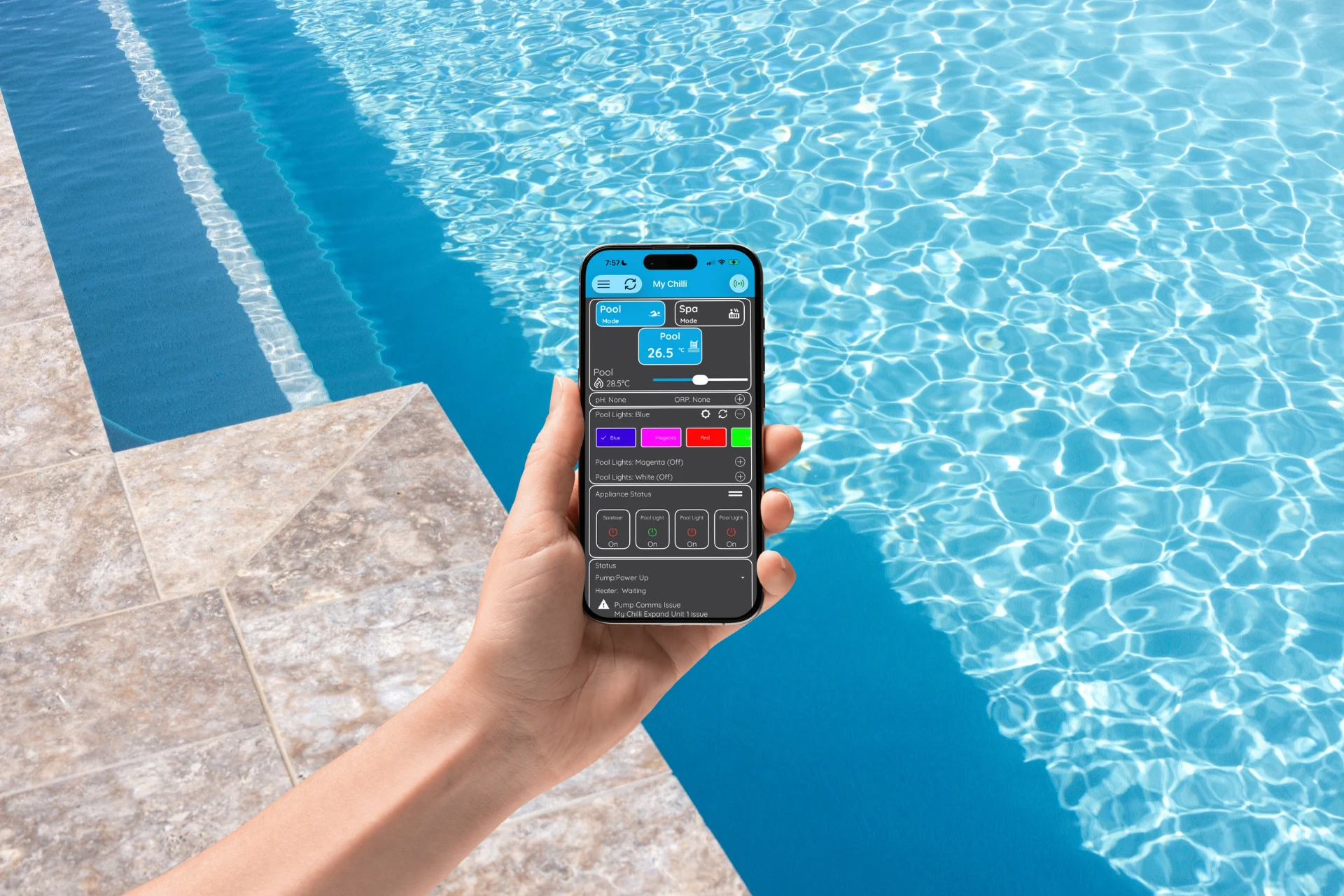
App control isn’t a gimmick - and the reason is simple: your phone is already where you manage everything else in your life, so why not your pool? With a connected system (and especially with ORP and pH sensors fitted), you can open the Summertime app and see how the pool is performing, check that the pump has run, watch your chemistry, and make adjustments on the run - from the office, the pool shop, or a holiday, particularly when everything is packaged in an integrated HushHub Control all-in-one equipment system.
The one thing an app can’t do is the physical jobs: pulling and rinsing your filter cartridge and eyeballing the pressure gauge. Everything else - modes, timers, dosing, heating - is at your fingertips. And because most people, frankly, do a patchy job of staying on top of their pool, having it in your pocket genuinely lifts the standard of care, which means less damage to the shell and equipment over time.
Where our system does something genuinely different: pool-and-spa combinations. Most systems in the industry, when you switch to spa mode, completely isolate the spa from the pool, which means while you’re using the spa, the spa water isn’t being filtered. Get out after a few hours with the family in it, and the water looks awful until the next day’s cycle. Our hydraulic setup runs a dedicated filter on the spa line, continuously drawing water from the spa, filtering and heating it, and returning it - so the spa stays filtered while you use it, and the same heating line can feed the pool when you switch back to pool mode. It’s a real engineering difference, not a spec-sheet line.
Where a pool heater fits (the short version)
Heating takes the chill out of the water so your swimming pool is comfortable and usable far more of the year, and lets you bring a spa up to temperature - with our electric heat pumps and solar heating options, a spa can go from around 16°C to 35°C in under three hours. A pool cover also reduces evaporation, holds heat more effectively, and improves heating efficiency. Different heating systems include heat pumps, gas heaters, and solar options. In the equipment circuit, heating always sits after filtration and before sanitising, so only clean water passes through the heat exchangers, and the pool heater never sees raw chlorine or acid.
Pool heaters help maintain comfortable swimming temperatures.
That’s the top-level view - heating is a big enough decision to deserve its own guide, and we cover heat pumps, gas and solar (costs, climate and what’s worth it) in detail there, including how heating can extend the swimming season by roughly 4 to 5 months in suitable conditions and why planning the right setup for a new pool is often more cost effective than retrofitting later.
Brands, warranties and the traps to avoid
On brands: Australia has high standards, and the safe approach is to stick to proven, reputable brands - Hayward, AstralPool, Maytronics, Zodiac, and our own Chilli range - over anything off a general hardware-store shelf. When you’re moving, treating and filtering water that families swim in, quality components aren’t optional.
On warranties - read the fine print. A “five-year warranty” is only as good as its conditions. Most warranties (ours included) exclude things like the pump’s mechanical seal, and all of them depend on you looking after the water. If equipment has been run in poor pH or high chlorine, the rubbers, seals and metals degrade - and that’s a fair exclusion, because those conditions are what killed the part. The trap buyers fall into is seeing “5 years” and assuming it’s unconditional. It isn’t, anywhere.
On buying cheap: the old line holds - the rich man pays once, the poor man pays twice. A pump that fails at 14 months, hours lost proving when and where you bought it because the builder left no paperwork, then paying for a replacement anyway - that’s the false economy. Pay the price for quality and proper installation, and you get the service and backup that go with it. Keep your purchase records, too.
Where to spend, and where to save on pool equipment
Spend on:
- The pump. Pump design is critical - how water enters and leaves the sump, the diffuser, the impeller material. A cheap pump that looks like a quality one isn’t. This is the one place never to cut corners.
- The filter. Same logic - look for proper standards and certification.
- Sanitisation and automatic dosing. This is where you buy back your time and protect your investment.
Be sceptical of:
- Water features. They have a mild circulation benefit, but beyond that, they’re often the biggest-spend items buyers are talked into and the least used. Barry’s seen plenty of capped-off pipes sticking out of the ground where a waterfall “was going to go” - sometimes because the bond beam wasn’t even poured to take the weight. Lovely idea; frequently, money is better spent elsewhere, especially when simple upgrades like smart, app-controlled pool lighting can transform how your pool feels in the evening for far less complexity.
The best-value upgrades, if you ask Barry what he’d tell a mate getting a pool:
- A quality robotic cleaner
- If you struggle to stay on top of chemistry, automated monitoring and dosing
Those are the two people most often wish they’d bought, and they’re well worth thinking about while you’re still at the planning stage and deciding whether and how to get a pool.
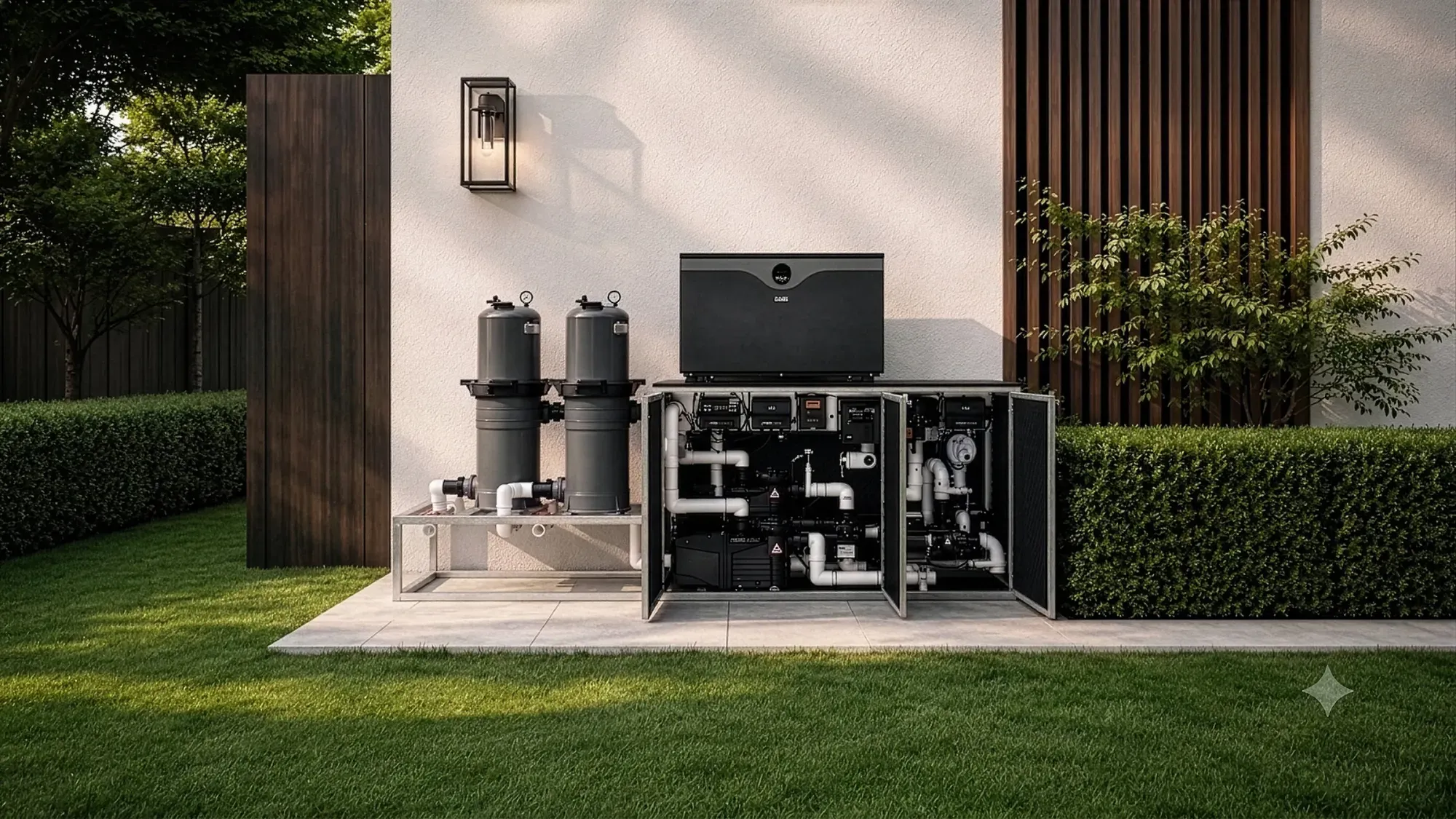
The HushHub Control
The problem you don’t know you have.
Here’s something most buyers don’t price in. The day the pool builder leaves, you’re often left with a stack of expensive equipment sitting exposed to sun and rain - and someone casually telling you to “cover that, you don’t want it out in the weather.” That’s a problem you didn’t know you had, and fixing it properly costs real money.
Our HushHub Control is the answer built in from the start: a purpose-engineered acoustic enclosure with all the plumbing run underground and up into it, so nothing’s on show, the equipment is protected, and the decibel-rated insulation cuts pump noise. Everything inside it is covered by a single five-year warranty and a single point of contact for service. When you’re comparing quotes, a rival’s “we’ll put a box around it” isn’t the same thing - and the difference is one of those things you only feel six months after handover.
About the Author.